
Two years ago, we discovered the Kingsbury Aerodrome, not more than thirty minutes from where we live. Its not advertised broadly, perhaps because those who need to know about it already know about it. The Kingsbury Aerodrome is a privately held 501(c)3 organization that is home for the fair and open house of the Pioneer Flight Museum. For this, don't think of a Museum like a building housing all sorts of artifacts. Think instead of a budding effort by an owner of a sod airstrip and a perhaps a 100 acres of once pastureland, plus some metal barns that are in the first stages of becoming storage places for vintage aircraft. And another vital component is the large number of members who are volunteers to take care of the site and help with the annual fly and drive in.
We missed last years fly in because we chose instead to go to Alpine to the convention of the Center for Big Bend Studies---its always on the same date as the fly-in. This year we chose the Fly-in as we did not look forward to the long drive to Alpine and a city where the sources of food is rather limited. Sort of like how many nights can one eat pizza at the chain?
Some of the old planes and cars belong to the Museum, but many belong to individuals who bring them to the Fly/Drive In. Here is a Ford Model A truck restored to near perfect appearance.
We missed last years fly in because we chose instead to go to Alpine to the convention of the Center for Big Bend Studies---its always on the same date as the fly-in. This year we chose the Fly-in as we did not look forward to the long drive to Alpine and a city where the sources of food is rather limited. Sort of like how many nights can one eat pizza at the chain?
Some of the old planes and cars belong to the Museum, but many belong to individuals who bring them to the Fly/Drive In. Here is a Ford Model A truck restored to near perfect appearance.
 |
| Ford Model A Truck |
The field of light planes totaled about 50--they were all fly-ins for the day. Dee talked for some time to a lady who had just arrived by plane. She was a widow---she and her husband both were pilots. He died and she carried on with flying their plane as her hobby. She flew in from north Texas. Her plane had some instrumentation, mostly a Google Maps system and she knew how to get to the general area, but when it came to finding the exact location she searched the ground from about 2000 feet and finally found the airstrip when she spotted all the planes on the ground. There is no ground controller, so its all visual rules. Since there are no markers for the runway, and it looks like nothing more than a mowed field, it would be hard to decide where to put the plane down.
 |
Field of fly-ins for the day
The dark brown top-wing plane in the right side of the photo is a carbon cub. Its made by Cubcrafters as an STOL. Pretty impressive performance too, with take off distance of only 60 feet and an equally impressive rate of climb. They sell ready made planes but they also sell the plane as a kit. Now, if I only had a barn big enough for the wingspan, I would consider building one. Just like the Snipe in the basement in New Jersey, but I couldn't pull off that trick with a plane built in my garage.
|
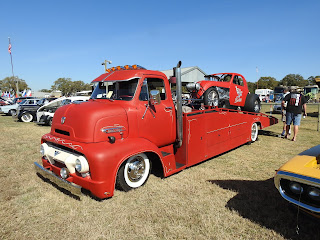
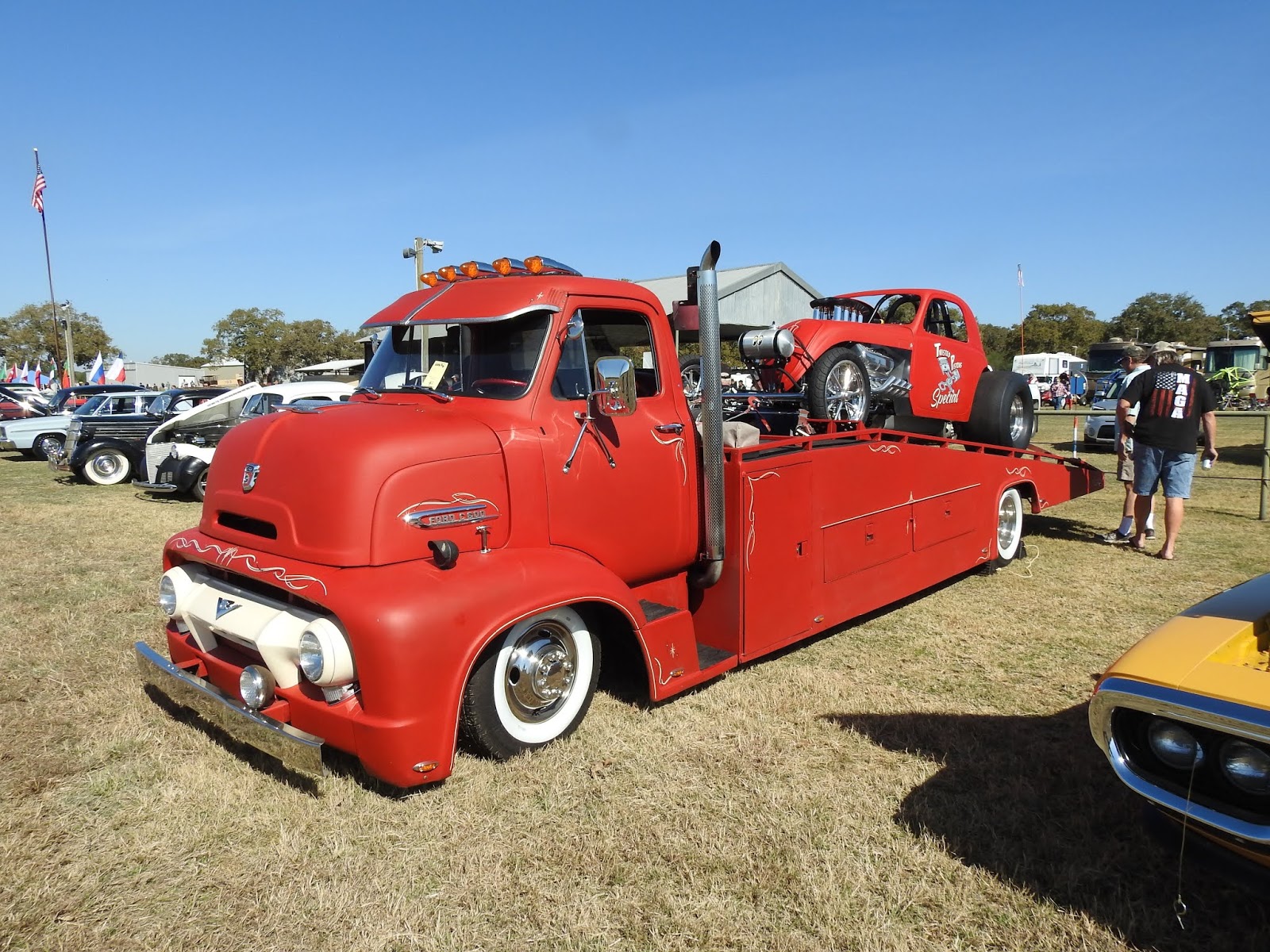
Here's an unusual truck that carries the owners hot rod. The truck obviously has a lift suspension as it is sitting right down on the blocks. The truck was part of a lineup of about 35 restored cars.
Below are a few of the very old airplanes in their collection.
 |
This is a Fokker Dr-1
The Fokker was made famous during the early days of WW I by Baron Von Richthofen, an air ace of Germany

Here is a French built Bleriot

And here is a Curtiss built JN-4
This was the common man's plane of the early days of flight. Its nickname was the Jenny, phonetics for the model name of JN-4
It seemed as if there were no tourists here, but only those who had a passion for old airplanes and cars and had some personal knowledge of each. My dad would have liked to have visited this area as he was a big fan of early flight. He had met Lindbergh, had toured Lambert Airfield on his trip "out west" in 1929 and was a frequent visitor to the airport in his hometown to mingle with the planes and pilots of the day. Incidentally, the book on his trip "out west" is currently in the draft stage and should be published before year end 2019.
Just discovered that there are two fly/drive-ins each year. Now we only have to wait six months to visit again.
|
Comments
Post a Comment